
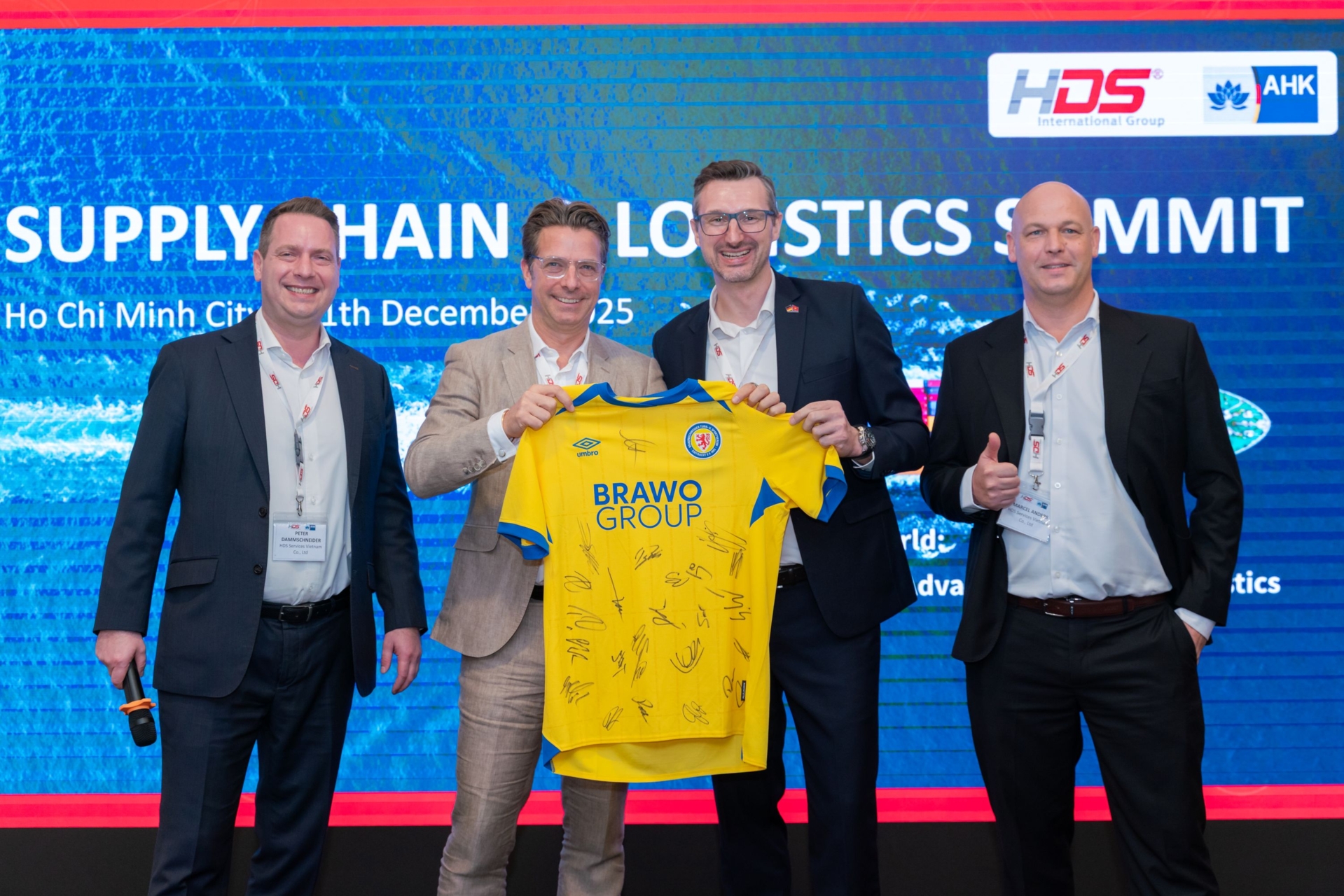
Ho Chi Minh City, 11 December 2025 – Against the backdrop of a rapidly transforming global trade environment, the Supply Chain & Logistics Summit 2025, hosted by HDS International Group and the Delegation of German Industry and Commerce in Vietnam (AHK Vietnam), convened specific business leaders and logistics experts from Vietnam, Germany, and beyond. The event served as a dynamic platform for dialogue on how Vietnam is positioning itself at the intersection of opportunity and resilience in global supply chain strategy.
Held in Hôtel des Arts Saigon – MGallery Collection, Ho Chi Minh City, the summit underscored Vietnam’s increasing relevance in regional and global logistics, driven by infrastructure investment, administrative reform, digital transformation, and strategic international partnerships.
The “New Normal” for Global Logistics
Under the theme “Strategic Logistics in a Volatile World: From Cost Control to Competitive Advantage”, the event opened with remarks from Peter Dammschneider (Director Sales Asia, HDS International Group) and moderator Elias Abraham (Managing Director, Cargonomics), who framed the day around actionable insights and collaborative dialogue.
In his keynote, Peter Kompalla, Chief Representative of AHK Vietnam, pointed out that “Vietnam is increasingly seen not just as a low-cost location, but as a logistics partner with the scale, skills, and stability to help global businesses thrive amid uncertainty.” He highlighted how new trade alliances, including the EVFTA and RCEP, are shifting sourcing strategies and creating fresh opportunities for ASEAN-based operations.
Infrastructure Investments and Industrial Readiness
Tran Minh Ngoc, Deputy Director Leasing – Key Account from BW Industrial Development, provided a powerful look into Vietnam’s investment in logistics readiness. The presentation detailed Vietnam’s expansion of deep-sea ports, new free trade zones (FTZs), and modern airport cargo capacities, especially at Long Thanh and Cai Mep–Thi Vai. She also introduced the concept of “satellite logistics hubs” designed to streamline urban delivery in mega-regions like the new Ho Chi Minh City agglomeration post-merger.
Legal Certainty in a Changing Landscape
Leif D. Schneider, Lawyer and Country Head of Luther Vietnam, broke down the immediate legal implications of customs reforms and new International Financial Centre (IFC) legislation. His session clarified compliance requirements under the amended customs law, especially for on-spot export-import operations and duty management in FTZs, crucial for manufacturers and Third-Party Logistics (3PLs) alike.
From Risk Management to Supply Chain Agility: Panel Discussion Insights
The main highlight of the summit was the panel discussion and Q&A session: “Building Resilient and Agile Supply Chains in Asia.” Moderated by Elias Abraham, the 90-minute panel featured key voices from German and Vietnamese logistics stakeholders:
- Vi Thanh Tuan (Vice President SCM & Logistics APAC, Schaeffler Vietnam)
- Tran Minh Ngoc (Deputy Director Leasing – Key Account, BW Industrial Development JSC)
- Ole Kehler (Director Business Development, CIMC Wetrans)
- Peter Dammschneider (Director Sales Asia, HDS International Group)
- Peter Kompalla (Chief Representative, AHK Vietnam)
Key insights included:
- Balancing Resilience and Cost-Efficiency: Thanh Tuan Vi shared how the company is reconfiguring its supplier network across Asia, focusing on predictive analytics and digital control towers to maintain performance while managing cost pressures. Nearshoring and multi-sourcing were emphasized as critical tools to reduce over-reliance on any single country or supplier.
- Container Efficiency & Multimodal Transport: Ole Kehler discussed how innovations in container tracking and equipment design are helping reduce turnaround times and optimize fleet utilization. He stressed that multimodal transport, especially in countries like Vietnam with improving infrastructure, is key to navigating disruption and scaling sustainably.
- Real Estate as a Strategic Enabler: Tran Minh Ngoc described how facility design has become central to supply chain strategy. She noted a strong tenant shift toward higher-spec buildings with energy efficiency, automation readiness, and flexibility, enabling customers to meet both operational and sustainability targets.
- German SME Support and ASEAN Diversification: Peter Kompalla emphasized that SMEs, in particular, need more support to diversify beyond China. He highlighted the role of the right connections and partnerships in navigating Vietnam’s regulatory landscape, identifying reliable partners, and accessing regional supply chain opportunities.
- Turning Logistics into Competitive Advantage: Peter Dammschneider concluded the panel with a pragmatic view: “Data is our strongest tool. With the right lane analysis and supplier benchmarking, companies can make smarter, faster decisions, and that’s where logistics stops being a cost center and becomes a competitive edge.”
A key takeaway: Agility is not the opposite of stability; it is the new foundation of it.
Interactive audience insights:
To deepen engagement, the panel incorporated a live poll, inviting attendees to share their perspectives on current supply chain challenges. The audience responses were reflected in the panel discussion, prompting lively comparisons and deeper reflection.
When asked about their biggest supply chain challenge, most participants pointed to geopolitical uncertainty and rising tariffs, followed by limited visibility and infrastructure gaps.
In terms of preparedness for disruptions, the average score was just above 3 out of 5—a clear signal that while awareness is growing, many companies are still catching up in terms of readiness.
The most relevant strategy for the next 12 months was digital supply chain monitoring, followed closely by supplier diversification and regionalization.
As for barriers to resilience, respondents cited regulatory complexity and high implementation costs as top concerns, echoing the call for stronger public–private coordination.
Finally, seaport capacity and cross-border trade routes were named the most critical infrastructure bottlenecks, pointing to Vietnam’s logistics transformation agenda as a timely and necessary effort.
This interactive session grounded the discussion in the audience’s real-world realities and reinforced that building supply chain resilience requires both structural improvements and strategic foresight.
Vietnam: From Logistics Location to Logistics Leader
As Vietnam’s economy evolves toward its 2045 development goals, supply chain modernization will be essential. HDS International Group, AHK Vietnam, and our partners remain committed to supporting companies with market entry, strategic partnerships, and on-the-ground expertise. For firms looking to invest in agile, sustainable, and high-potential supply chains, Vietnam is more than a destination; it is a strategic partner.
Contact for Media
Download the event album via this link.


